


They say that those who wait for True Love are lucky…Or not. Some say that True Love exists…While others, seemingly too sad and dejected, say that it does not.
Some try and try and try…And give up.
Others try and wait, try and wait…
While still others just Wait…
For the Right One…An Angel that Completes their Angelicity. Which carries them both to their Destiny…And Forever…
I am fortunate to have found such an Angel. I’ve had to go to the opposite side of the planet to find her, for the woman here on this side of the planet find me not to their liking. This is a long and fairly torturous story…Best told elsewhere.
The boy in the story above is Leonardo da Vinci. Considered one if not the foremost genius and polymath in all of history, he did find his Angel, his Great Love. Unfortunately, she was already married and thus forever denied to him. But he painted her likeness and carried it with him for the rest of his Life, turning down offers to sell it even when he could have used the money that it would have brought.
Nowadays, this one painting of his is enshrined in a great museum in France, the place of his adopted home country, and draws millions of visitors each and every year. There are a lot of very fanciful ideas and theories about just who is this mysterious woman in the painting but Vasari, the only real biographer of Leonardo da Vinci and many other artists of his era tells us quite plainly and directly:
“Leonardo undertook to execute, for Francesco del Giocondo, the portrait of Monna Lisa, his wife; and after toiling over it for four years, he left it unfinished; and the work is now in the collection of King Francis of France, at Fontainebleau. In this head, whoever wished to see how closely art could imitate nature, was able to comprehend it with ease; for in it were counterfeited all the minutenesses that with subtlety are able to be painted, seeing that the eyes had that lustre and watery sheen which are always seen in life, and around them were all those rosy and pearly tints, as well as the lashes, which cannot be represented without the greatest subtlety. The eyebrows, through his having shown the manner in which the hairs spring from the flesh, here more close and here more scanty, and curve according to the pores of the skin, could not be more natural. The nose, with its beautiful nostrils, rosy and tender, appeared to be alive. The mouth, with its opening, and with its ends united by the red of the lips to the flesh-tints of the face, seemed, in truth, to be not colours but flesh. In the pit of the throat, if one gazed upon it intently, could be seen the beating of the pulse. And, indeed, it may be said that it was painted in such a manner as to make every valiant craftsman, be he who he may, tremble and lose heart. He made use, also, of this device: Monna Lisa being very beautiful, he always employed, while he was painting her portrait, persons to play or sing, and jesters, who might make her remain merry, in order to take away that melancholy which painters are often wont to give to the portraits that they paint. And in this work of Leonardo’s there was a smile so pleasing, that it was a thing more divine than human to behold; and it was held to be something marvellous, since the reality was not more alive.”
- Giorgio Vasari, “Lives of the Most Eminent Painters, Sculptors, and Architects”, 1550
Leonardo painted this painting with great skill and care. Four years went by and he was not finished with it and thus did not deliver it to the commissioner. Indeed, Leonardo seemingly never finished this one particular painting. He kept it with him as I’ve said, throughout his remaining life, working on it in small and delicate ways from time to time from just his memories. And what important memories they must have been! He never thought it complete…For the Love that it represented to him was never completed.
It is very obvious to a DaVinci Mind, a person that has a Self-Evolved advanced mind, that this painting represents exactly what Vasari says that it is…And a secret story of Forbidden Love. In those days there was no divorce. Nor could a woman of social stature associate with a commoner, especially one who was a bastard. Nor were there anywhere for two Lovers to flee to and live happily ever after.
There is no real secret about the Mona Lisa. No mysterious person who it represents other than the one stated by Vasari. Lesser developed and evolved minds continually find mysteries and hidden secrets where there are none, as evidenced by the “mystery” of her eyebrows and eyelashes– They are missing in the painting now. Did she not have eyebrows and eyelashes? Did Leonardo not paint them for some secret reason? What happened to them? To find the Answer one just needs to read original sources or near original sources. Something that seems to be little or never done nowadays. A Mind like Leonardo’s always searches for original works not the words of others – “Experience is a truer guide than the words of others” – And Vasari is the closest that we have in terms of experience with both the Mona Lisa and Leonardo.
Vasari said in 1550:
“…as well as the lashes, which cannot be represented without the greatest subtlety. The eyebrows, through his having shown the manner in which the hairs spring from the flesh, here more close and here more scanty, and curve according to the pores of the skin, could not be more natural.”
- Giorgio Vasari, “Lives of the Most Eminent Painters, Sculptors, and Architects”, 1550
Vasari, whom we owe quite a debt to for without his writings we would know essentially nothing about Leonardo da Vinci (and many other great painters and artists of that era), quite clearly tells us that both the eyebrows and eyelashes did exist and were painted with spectacular life like detail. They most obviously were lost over time as the painting was restored and restored rather poorly, at least in this regard.
The main treasure of this painting though, is the smile. The smile of the Mona Lisa is quite renowned due to the mysterious and enigmatic nature of it. Leonardo’s consummate skill in life like painting is perfectly demonstrated here where he went beyond life like into an entirely new realm:
“…in this work of Leonardo’s there was a smile so pleasing, that it was a thing more divine than human to behold; and it was held to be something marvellous, since the reality was not more alive.”
- Giorgio Vasari, “Lives of the Most Eminent Painters, Sculptors, and Architects”, 1550
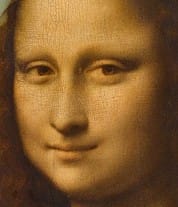

The smile of the Mona Lisa has intrigued people for centuries. Many are the theories of what it means. How it was produced is known as it uses a painting technique that Leonardo developed after much experimentation with light and shadow and paints and tints and painting techniques. Leonardo called this technique “Sfumato” which is derived from the Italian word “fume” meaning “smoke or fume”. Translated into English, the word means something like “soft” or “blurred”. Leonardo himself wrote that it “was without lines or borders”. Other artists adopted and used this technique but none with the mastery of Leonardo.
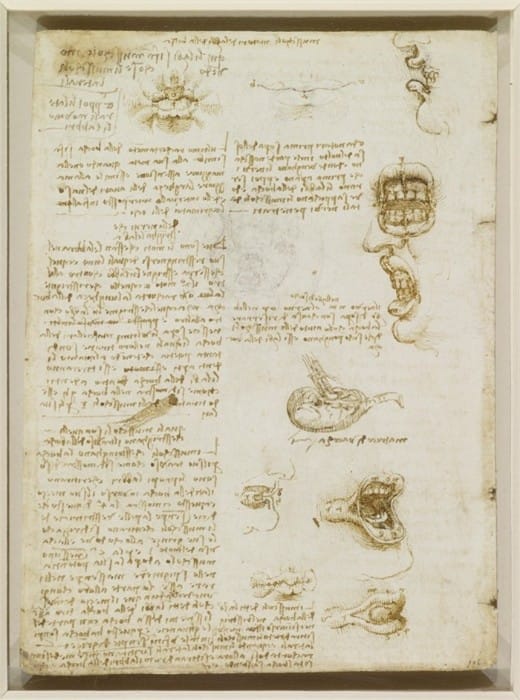
Leonardo work on this painting for the next 16 years until his death in 1519. His extensive studies of anatomy were put to good use in understanding how the muscles of the face produces smiles with their underlaying contraction and expansion.
We see in these efforts and behaivour the deeper insights and higher Mind characteristics of what I now term “The Leonardo da Vinci Mind” or just “DaVinci Mind” for short:
· Original research for in-depth understanding.
· Not content for superficial “overly simple” answers.
· Dives deep for Deep Understanding.
· Does own research where no research or adequate research exists.
· Kaizen – Continuous improvement of both skill and understanding.
· The desire to perfect something as much as it can be perfected.
· Dedication to an Ideal (in this case Love).
· Focus on Reality instead of illusion.
· Hard work.
· Hard thinking.
· Self-Initiative and Self-Motivation.
All of these intrinsic behaviours of Leonardo da Vinci were quite necessary to produce the master piece of the Mona Lisa. But Leonardo did not paint the Mona Lisa for us…He painted it for himself. As a tribute and honoring of that which he touched but could not hold.
The enigmatic smile of the Mona Lisa to me is easily explained by a simple idea: The smile is not a single smile but rather three different smiles overlaid very artfully upon one another. They represent three different smiles from three different times in which Leonardo saw her smile special smiles and sought to capture combined in a single painting as a memory of his Love.
The First Smile is quite simple to deduce. Vasari said that Leonardo:
“Monna Lisa being very beautiful, he always employed, while he was painting her portrait, persons to play or sing, and jesters, who might make her remain merry, in order to take away that melancholy which painters are often wont to give to the portraits that they paint.”
- Giorgio Vasari, “Lives of the Most Eminent Painters, Sculptors, and Architects”, 1550
And that is the First Smile, a smile of amusement and pleasure, that if one but looks a bit deeper is quite obvious and strengthen by the amusement in her eyes.
The Second Smile is less obvious. It is a smile of a woman shining with Love. If you have ever seen this type of smile and shining then you will Know. If not, then be advised that it is a most special smile and shining eyes which seem to project Love directly from them both that penetrates to your Heart and moves it greatly. It is truly a sight to behold. And it demonstrates the depth and Soul of any and all woman who can smile and radiate thusly.
The Third Smile is a sad and furtive smile of loss and longing. You can see it in the eyes which look not directly out at you or even close to it. The eyes look away as if in knowing that they will not ever see him again. Caught just before they complete the movement and look downwards in loss and hurt. Leonardo caught this look, and it imprinted upon his mind and haunted his Soul for the rest of his life, when he looked back when leaving her for the last time and caught this moment transitioning from Love to the Despair of Forbidden Love. The moment two Hearts and two touching Souls were forever ripped apart by the irreconcilable social laws that forbid True Love.
Leonardo took this moment with him from ever more. And when it came time to paint her smile from memory this, and the other two memories where predominant so he painted all three of them together, overlaid and blended in together, into the single painting the represented the great and lost Love of his life.
That Leonardo never delivered the painting, and the commissioner never demanded it as was his right by law, says much in understanding the Mona Lisa. Proof of this technique is actually rather easy, for all that needs to be done is to capture in photographs three photos of these three states (not easily done) or a simulacrum of them (more easily done) and then using computer graphics blend them together to duplicate the smile and the eyes of the Mona Lisa. The Secret of the Smile is thus revealed.
The Secret of Leonardo’s Love for the Mona Lisa is not really a secret to those who have some experience with Love. Leonardo’s behaivour is ample obvious proof of that to us. The exact details are lost to history and to us…But perhaps that is not really necessary to Know, the Smile saying it all.
To me and for me, this makes Leonardo in my eyes, the World’s Greatest Lover for he captured the essence of Love and Forbidden Love, a problem for many throughout history and cultures, in a timeless way that Remembers that Love, and the three moments…Forever.
For what is Love if it cannot be Forever?
Source: https://www.theatlantic.com/magazine/archive/2017/11/leonardo-da-vinci-mona-lisa-smile/540636/


